Learning from Las Vegas 2.0
In November 2016 Donald Trump was elected president of the United States. The building industry’s current focus, from which Trump made a good deal of his fortune, is reaping no benefits to either our (grand)children or our climate. In this article I propose that he lays down his weapons of mass consumption.
Trump’s businesses account for a large amount of consumer goods and construction of real estate. He is therefore a large contributor to the (building) economy in the US and abroad. But does his track record, that has been effectively utilised in his presidential campaign, also strengthen the economy in the long run?
Life out of balance
First, let’s rewind to the early 1980’s, when Trump Tower was being erected in Manhattan. This era is beautifully visualized in Godfrey Reggio’s film ‘Koyaanisqatsi: Life out of balance’ (1982). It visualizes mass industrialization and mechanization in America by endlessly showing urban masses flocking from suburbs to their jobs, located in business districts. The sustainability of this planned building economy is questioned by images of failure, such as the demolition of the Pruitt-Igoe housing project in St. Louis. The mass-produced high-rise project was demolished only twenty years after being built. Reggio claims such developments have led to an imbalanced relationship of humans, nature and technology.
American cities continue to serve as a playground for the building industry in the 21st century. Unfortunately money isn’t being invested in a more evenly balanced and sustainable environment. The real estate sector has taken urban planning hostage and is pushing it to its economic limits. This makes me wonder why studies by urban theorists to reconnect architectural thinking to the building trade haven’t caught on.
The Harmon fiasco
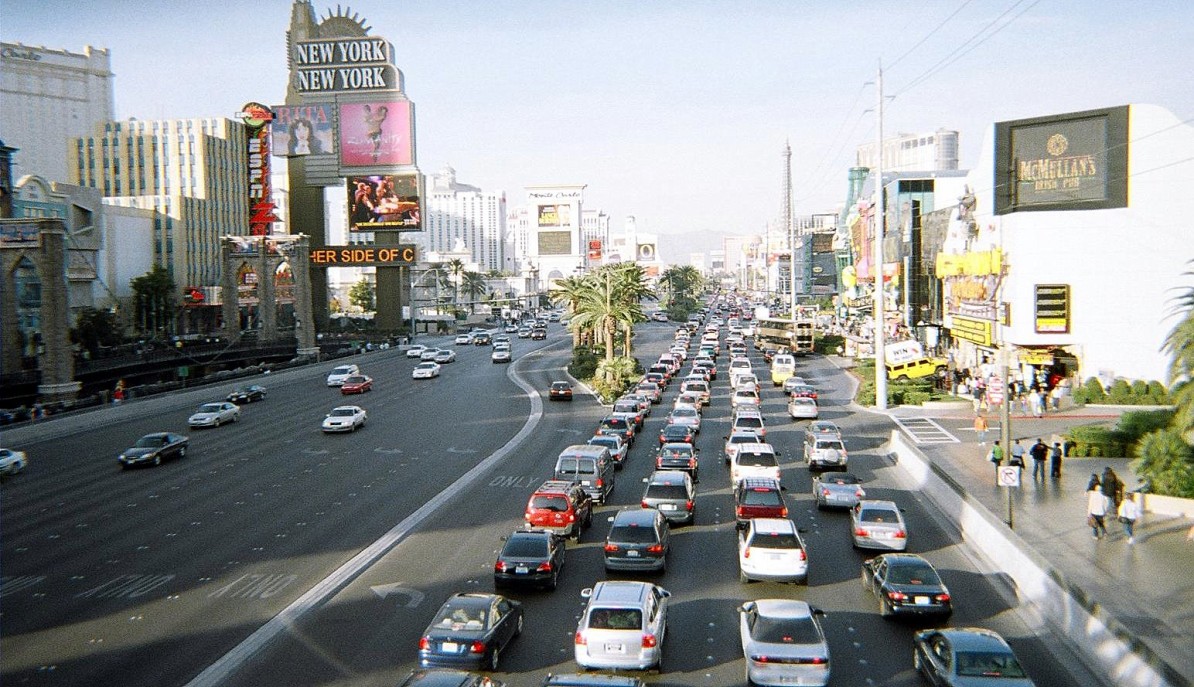
Robert Venturi and Denise Scott Brown were teaching at Yale in 1968 when they decided to set their students on a plane to Las Vegas to study the (now famous) Strip. This amalgamation of casinos, hotels and immense parking lots was the early urban expression of venture capitalism. Interestingly, Venturi and Scott Brown approached the Strip on its own terms and analysed it for future generations to expand on. ‘Las Vegas is to the Strip what Rome is to the Piazza’, they declared, placing it in a context of urban planning. They were the first to care about the urban logic of the Strip, defining existing qualities and possibilities for future transformation.
The 21st century Strip still thrives and continues to fascinate. In fact, it has grown beyond imagination. But to understand its current logic you will need a real estate handbook rather than Venturi and Scott Brown’s research. The Strip is being exploited as Nevada’s nr.1 economic powerhouse. Under this heavy economic pressure, things tend to go horribly wrong every now and then. In 2009 the construction of the 49-story Harmon Hotel was prematurely suspended. Without ever having opened its doors to visitors, it was approved for demolition in August 2013 because of construction flaws. The design by Foster & Partners was part of a huge multimillion development commissioned by MGM Resorts International. Even though the Harmon Hotel construction backfired dramatically, all the other high-rises in the urban scheme were completed and now deliver revenues. Yes, the Harmon Hotel’s construction failure was a spot of bother. However, it didn’t ruin the complete plan in the accountant’s book. In the financial balances of the real estate industry, these types of mistakes can apparently be brushed away, continuing as if nothing happened. However, the Harmon Hotel really was a complete waste of material, labour and money and serves as an example of real estate investors’ indifference to making good cities.
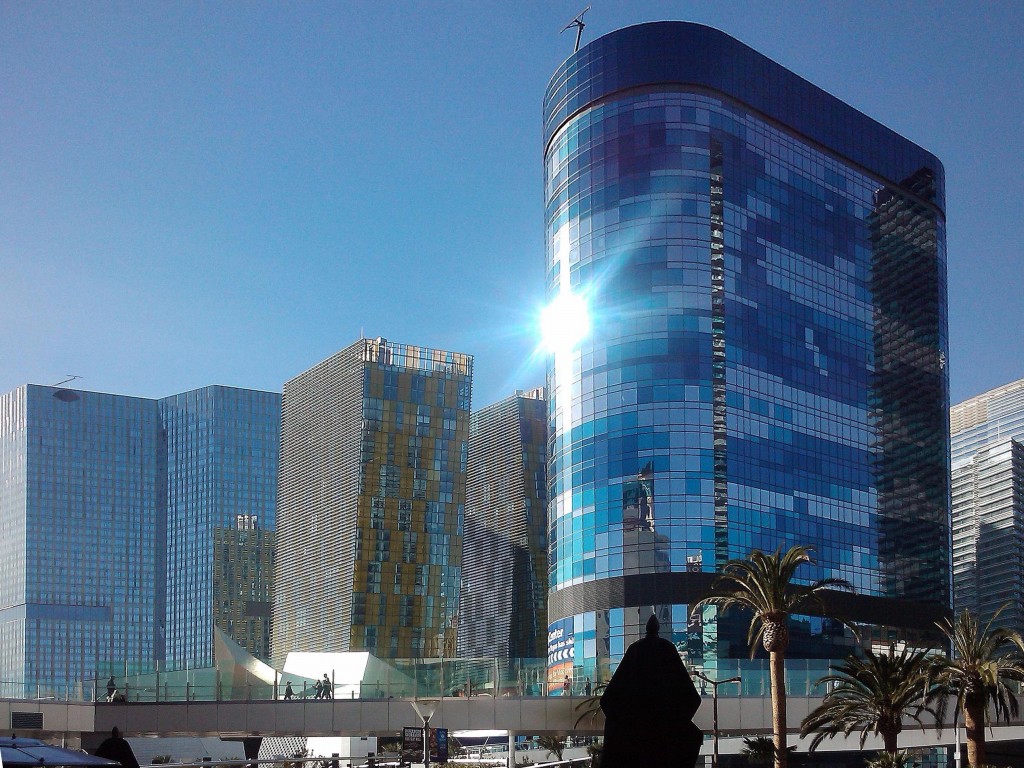
The mirrored glass-facade of the Harmon Hotel, that would never be used as a hotel. Photo: Mike Russell via Wikimedia
This embodiment of highly competitive venture capitalism is diametrically opposed to the inquisitive nature that Venturi and Scott Brown deployed to the Strip. Instead of projecting the blunt logic of real estate investment, the Yale professors and their students tried to understand its logic. If planners would have built upon their research, the inherent qualities of the Strip might have become part of a discourse on urban planning. That might have lead to knowledge to be deployed in similar leisure-driven cities around the globe, such as Dubai or Macau, where brand new always seems to win over the (natural) process of ageing.
Longevity
It seems that transformation and adaptive reuse is almost non-apparent in places where real estate market forces rule. Stewart Brand, author of ‘How Buildings Learn’ (1994), stakes a claim for the gradual renovation of buildings. He explains how buildings can be adapted to different or even unintended types of use over time. He claims the main reason that buildings aren’t nurtured by their owners is because the building industry degrades the longevity of buildings simply by utilising materials that deteriorate fast or adapt badly to extreme climates. Ironically, we did learn how to build trustworthy and resilient buildings centuries ago. Why didn’t we use this knowledge to enhance our constructive and architectural endeavours?
Real estate money nowadays dictates which buildings are to be constructed with posh materials and which buildings (usually in areas of lower economic welfare) have to make do with flimsy constructions and facades. The building industry isn’t interested in building quality if there is no revenue to account for it. Too often buildings are constructed for a short-term profit. Corresponding design briefs are reduced to the lowest standards. The building industry is basically creating weapons of mass consumption. Such a consumer-driven production industry creates indifference and thwarts care for the built environment. When this process really kicks in, only one outcome prevails: demolition. Leading to more Pruitt-Igoe or Harmon Hotel-disasters.
Reuse
Donald Trump’s presidential campaign has encouraged Americans to stick to their consumerist habits rather than opening up possibilities for a enviromentally balanced, circular economy. The life cycle of building products needs to change rapidly to reach worldwide environmental goals, therefore adaptive reuse is a necessity. Most buildings we need in the next couple of decades have already been built and must be studied and analysed for gradual adaptation, rather than being demolished. When deployed effectively, reuse of America’s building stock could actually be an asset to make America great again!
A previous version of this article was published in 12-FORUM –BRIEVEN/AetA that can be ordered through the (Dutch) website of Architectura et Amicitia.


