Testcase Making City
‘Making City’, the 5th International Architecture Biennial Rotterdam (IABR) kicked off on April 20th, 2012. Have the exhibitions, debates and the experiments on the Test site managed to open up new perspectives on how to make city?
Coming out of Rotterdam Central Station, yellow signs on the window of a local coffee bar shout out that here ‘It’s all about making city’. Followed directly by ‘It’s all about making good coffee’. Apparently making city and good coffee go hand in hand? Think about it: the coffee serves perfectly as a metaphor for what modern-day processes of urban regeneration need. When drinking coffee we converse, make plans and (with some imagination) dan feel the energy flow. The effect might only last an hour or so, but continuous consumption allows us to maintain an attitude of relentless tenacity through days, months or even (many) years; providing the energy we need to make meaningful and lasting changes to our cities. Taking the coffee-factor out of account for a moment, let’s ask ourselves if the 2012 Rotterdam Architecture Biennial has managed to energise the debate and the future of our cities.
Making City
Yellow was chosen as the main color for communication purposes by the organisation of this Biennial – a color commonly used to indicate emergency. Its strategic use supports the wake-up call put forward by the curators, whose task was to lay bare future challenges in cities around the world. The main exhibition Making City in the Netherlands Architecture Institute (NAI) claims that we have arrived at a pivotal point in history: ‘This truly changes everything’. No longer can we afford a business-as-usual attitude; it’s time for a radical upheaval of processes that define making city. The text sets the scene for the exhibition – let’s start making city immediately, before it’s too late!
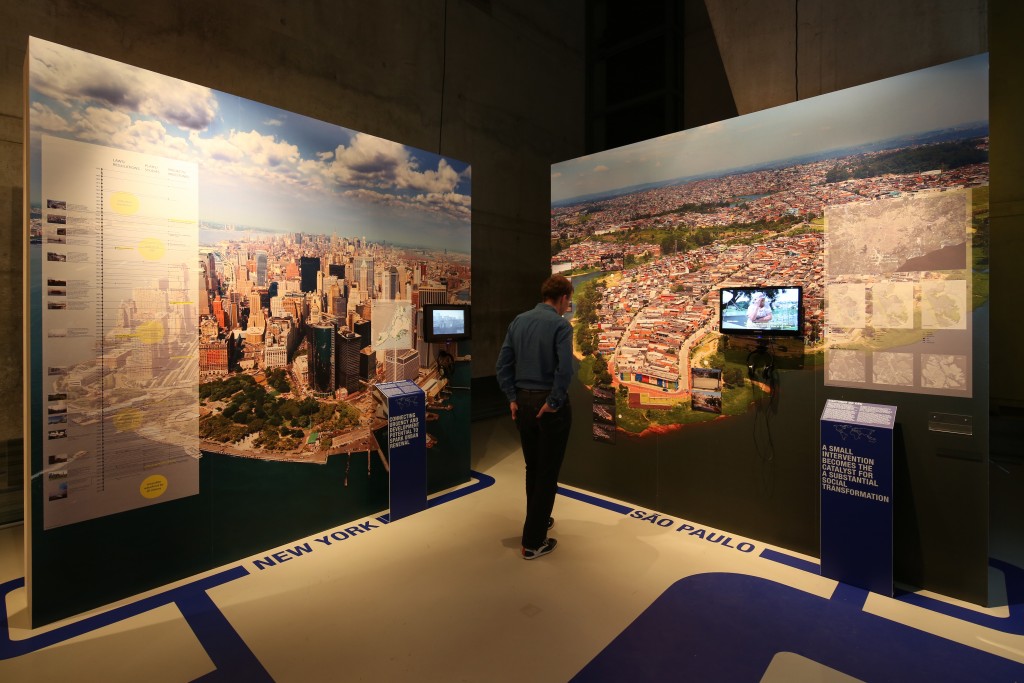
Main exhibition IABR 2012 Making City in the NAi. Photo: Ossip van Duivenbode
Lack of urgency
Inside, thirty-three examples from different design and research teams illustrate how they intend to make cities through new methods. The attitude of most contributions is all about signalling challenges. The boldness that one might expect of designers, to come up with research-by-design solutions, seems almost non-existent. Some of the contributions fail to point out where the suggested process of making city might lead, paying too much attention to the characteristics of a certain site or problem. The thorough and investigative nature of many projects might be applauded and they certainly serve as a testimony to the long hours that must have been spent working on them. However, there is a general lack of accuracy that might provoke visitors into a ‘we-must-act-now’-attitude that the curators have put forward so fiercely.
Delta regions
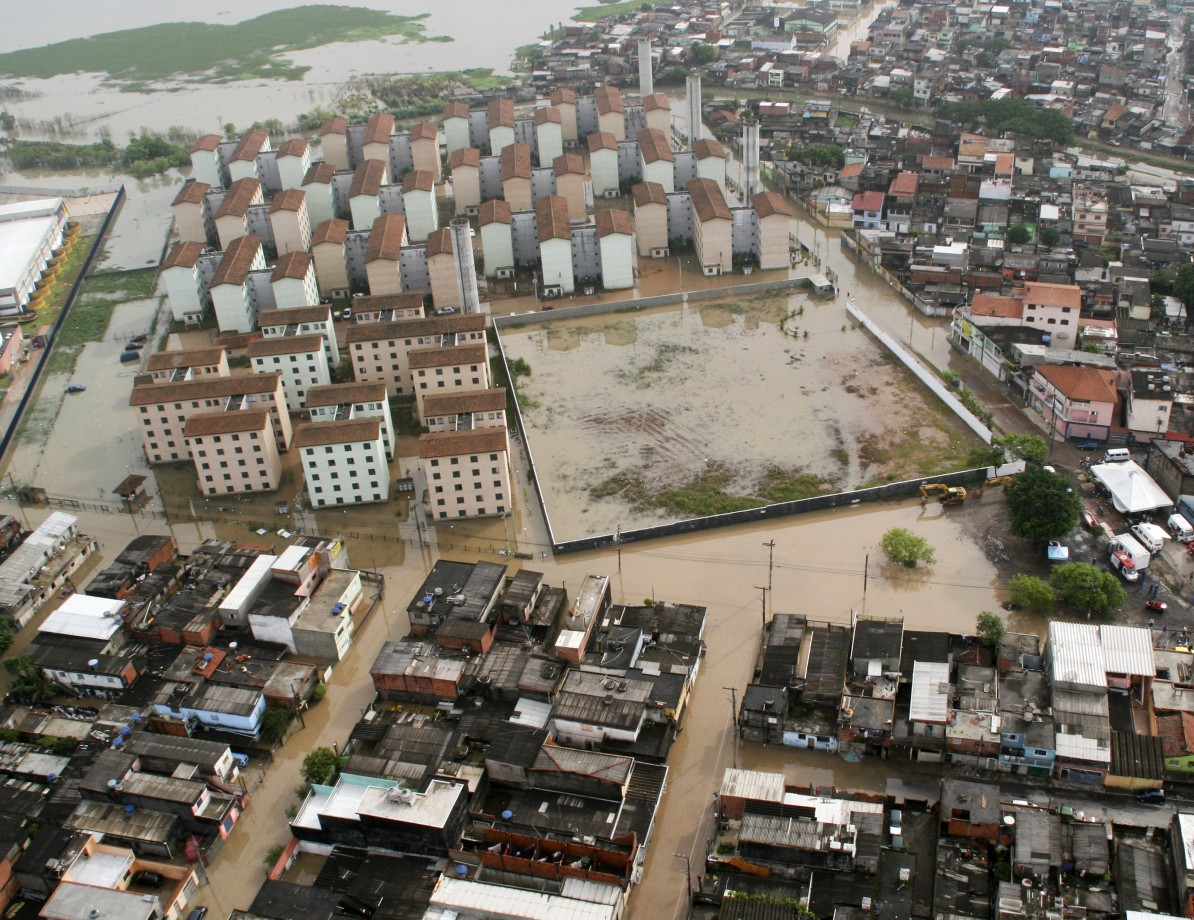
One of the aspects that contributes to this lack of urgency is the almost unlimited amount of information on display. In an attempt to categorise the thirty-three contributions, nine main themes are singled out. Perhaps the most convincing one looks into future scenarios of climate change and the topic of rising water levels. It lays bare the threats that endanger our very existence on this planet and question our collective power to respond with global responsibility to this subject. The proposals are geographically very diverse: ranging from New York’s waterfront, Italy’s Veneto region, the Rhine-Meuse Delta region in the Netherlands to Cantinho do Céu, a suburb of Sao Paulo. Conclusion: the common problem is not the threat of water itself, but the fact that these areas are highly populated and a large number of people will suffer once the water comes bursting through. So why do we continue to expand cities in high-risk river deltas? Isn’t it time to reconsider the location and design of human settlements to prevent the risk of causing life-threatening situations? It remains to be seen if national and local governments are apt to respond to this wake-up call. The research at least points clearly to the need for action.
Testing testing
Meanwhile in Rotterdam a summer of coffee drinking has gone by – including some actual building activity. The architects Elma van Boxel and Kristian Koreman of Rotterdam firm ZUS, responsible for one of the Biennial’s ‘Test Sites’, have led by example. Their Test Site consists of a post-war office block, that was re-energised a couple of years ago after years of decline. Van Boxel and Koreman squatted the building in order to re-connect it to the city. To show that this formula actually works, activities in and around the building were organised during the summer, including a German-style Biergarten and a green rooftop for growing crops. The opportunistic project by the name of the Luchtsingel (sky bridge) is the Test site’s main attraction: an elevated walkway that connects both sides of the train tracks. The walkway isn’t completely installed yet, but it’s getting there, piece by piece. Recently the walkway was extended, spanning a heavily trafficked thoroughfare in Rotterdam’s city centre. In the next phase the Luchtsingel will cross the train tracks. Although work has only just started in Rotterdam, it’s already clear what the preferred way is of going about making city: and that’s learning by doing. It also answers to the sense of urgency that the exhibition lacks and provides an interpretation to the curators’ bold statements. It could also been interpreted as a confirmation of Rotterdam’s no-nonsense, rolled-up-sleeves-mentality? It has certainly helped, but don’t forget the coffee-factor either.
This article was published in Mexican Architecture magazine Arquine, issue #61, under the title “Caso de Prueba Making City”.
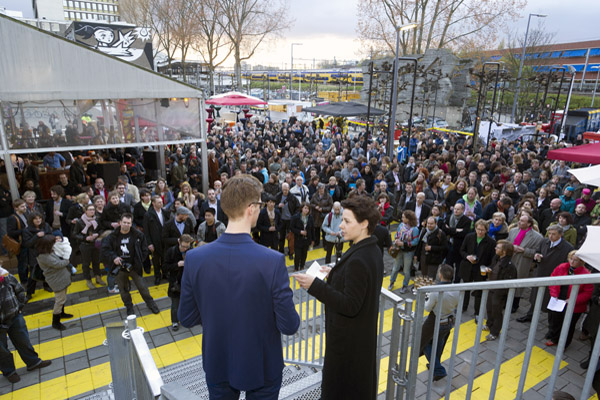
Opening Test site Rotterdam with Kristian Koreman and Elma van Boxel (ZUS). Photo: IABR


